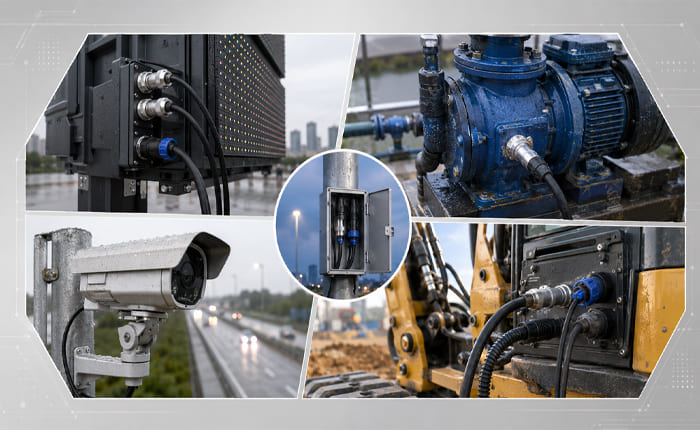
Outdoor equipment interfaces should be specified before a cable harness is finalized because the cable, connector, enclosure, and installation orientation influence one another. If a team chooses the harness first and treats the connection point as an afterthought, it can discover late that the cable exits toward an obstruction, the mating area is hard to reach, or the installed interface does not match the expected exposure. Early interface definition prevents those corrections from becoming production changes.
Describe the actual setting in operational terms. An outdoor cabinet may be protected by a canopy, mounted on a frame, placed near washdown activity, or installed where wind-driven debris reaches one side more than another. A solar or power-related enclosure may have different cable routing constraints from a roadside control box. Record the direction of exposure, maintenance access, and whether the connection will be opened during field work. These details guide the layout without relying on vague descriptions such as harsh environment.
The cable harness needs a clear endpoint. Specify whether the connection is on a panel, at the end of a lead, or incorporated into a larger assembly. Show the preferred cable exit direction, the available bend space, and the location of supports or clamps. If the interface will be near a door or removable cover, note the travel path and the required slack. A harness can only be built consistently when the mechanical envelope is known.
For outdoor designs that use compact threaded interfaces, waterproof circular connectors can serve as a product-family reference when discussing M5, M8, and M12 options, as well as cable-end and panel installation. The final choice should be documented against the actual installed assembly, including the connector pair, cable design, mounting condition, and maintenance method.
Do not treat an environmental label as a substitute for assembly detail. The performance of a finished connection can depend on how both mating halves are used, how a cable enters or leaves the interface, and how the panel installation is completed. For that reason, the design review should state the exact condition that needs to be examined during sample evaluation. A requirement that applies only after mating or after installation must be written that way in the project documentation.
Outdoor service access deserves its own check. A technician may wear gloves, work from one side of a cabinet, or need to support a cable while loosening a coupling. Review the interface from that point of view before the layout is released. If the intended action requires removing unrelated hardware or bending the cable beyond the planned route, the connection may be technically possible but operationally poor. Small layout changes can be easier than later service instructions that ask people to improvise.
The handoff between mechanical design, electrical design, and harness production should list the same facts. Mechanical drawings can establish the panel and clearance; the electrical schematic can identify function and counterpart; the harness drawing can describe cable construction and termination. A shared interface table ties those records together. It reduces the chance that one team changes a connector orientation while another team continues to build to an earlier assumption.
A well-specified outdoor connection is an installation decision as much as an electrical one. Define the exposure, mated state, physical location, cable route, and service action before approving the harness. Then validate a sample in a representative arrangement. This approach produces documentation that is easier to build from and easier to maintain when the equipment moves from drawing to field deployment. The release package can include a simple installation photograph or drawing that shows the finished cable direction, support points, connection orientation, and areas that require clearance. This is often more useful to a harness builder than a connector description on its own. It also lets the equipment owner review whether operators or service staff will approach the interface safely and consistently once the outdoor unit is installed in its intended position.

Salut. Numele meu este Daniliuc Marcel Catalin. Mă consider o persoană melancolică iar, de cele mai multe ori, starea mea de spirit este influențată de poveștile auzite, cărțile citite, filmele văzute etc.